Denoise a recording
Question
What signal remains after removing noise?
See every package-generated example · Read the complete analysis pipeline
When to use
Use this to suppress noise while retaining the underlying sampled trace.
Example figure
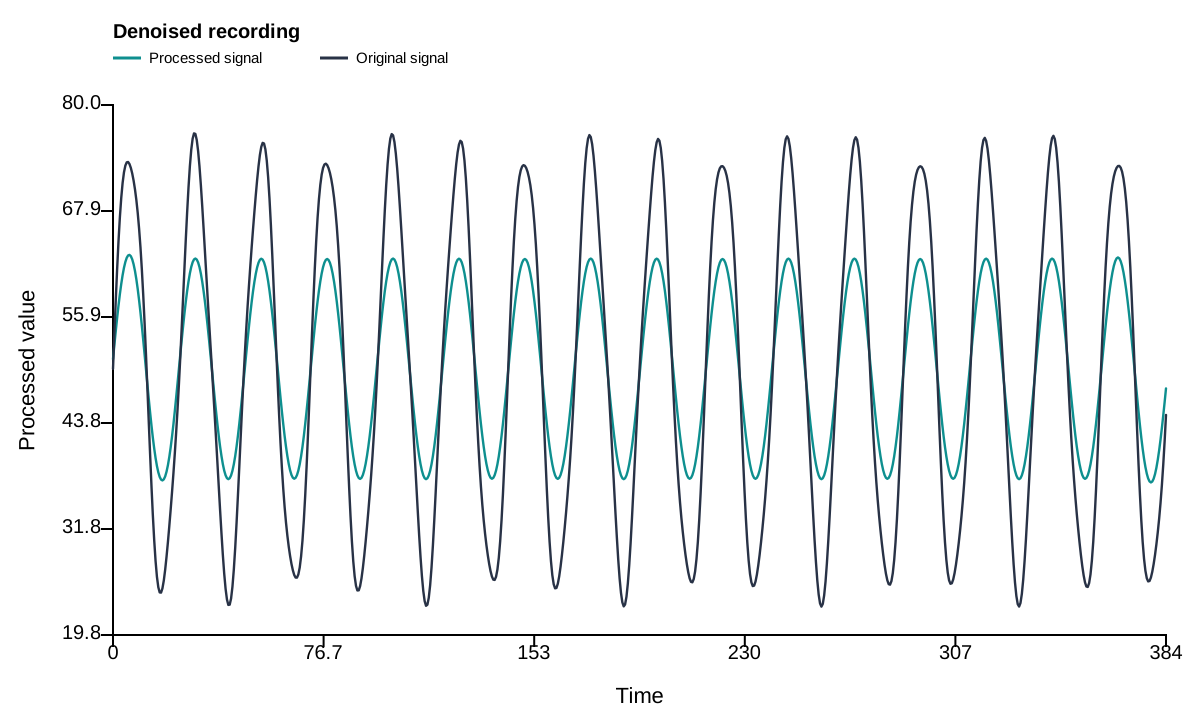
This deterministic example is calculated by the denoise action and drawn by render_denoise_svg, the same renderer used for publication export. Empty or withheld elements are therefore visible exactly as they are in a real result.
import circadian_workbench as cw

cw.call("denoise", recording={"path": "mouse01.awd"})
Required inputs and controls
The public function is the registered action below. settings= is accepted as a friendlier alias for config= by cw.call; the calculation stores the complete normalized config in provenance.
Function reference
cw.call("denoise", recording, config=None, ssa_window_hours=24.0, ssa_components=2)
Arguments and parameters
| Name | Type | Required | Default | Units | Meaning |
|---|---|---|---|---|---|
recording |
recording spec | yes | — | - | The record to analyse: {'path': 'data/m01.awd'} (a bare path string also works), {'demo': true} for the built-in deterministic record, {'inline': {'filename': ..., 'text': ...}} for tabular text, {'trace': {'hours': [...], 'values': [...], 'name': ...}} for one elapsed-time trace, or {'channels': {'hours': [...], 'values': {'reporter_a': [...], 'reporter_b': [...]}}} for several measurements from one subject. A returned processed_trace spec retains transformed values, their original clock, source identity and explicit processing history. Versioned recording_snapshot specs are self-contained numeric inputs for replaying in-memory Recording objects; they do not invoke a raw-activity importer. |
config |
object | no | null |
- | Partial scientific settings. Omitted or None values use the shared installed defaults; invalid fresh values are rejected. Run describe_config for names, meanings, units, bounds and choices. Explicitly load old saved mappings with load_saved_settings to report compatibility conversions. |
ssa_window_hours |
float | no | 24.0 |
hours | Singular spectrum embedding window; each uninterrupted segment needs at least twice this many samples. |
ssa_components |
integer | no | 2 |
count | Leading singular components retained during diagonal reconstruction. |
Every nested config key, default, allowed value, and purpose is listed in the complete configuration reference.
How it works
The chosen denoising method acts on valid segments and preserves missing samples.
$$ y_{\mathrm{clean}}=D(y) $$
Implementation: analysis.py::denoise.
Outputs and interpretation
The result contains original and processed values, method settings and segment coverage.
cw.call returns a Result: use .data for calculated values, .warnings for scientific qualifications, .provenance for version and input identity, .script for an equivalent replay script, and .files for saved outputs.
Limitations
Smoothing can remove brief biological events as well as noise; compare with the original.
Example
The figure above is a real package result from a seeded, redistributable synthetic dataset. The flat gallery bundle retains figure_data_denoise.csv, a standalone plot_denoise.py, source hashes, an editable SVG, and a rendered preview.
Methods text
The selected denoiser was applied to valid recording segments and missing data were preserved.
See also
Remove a slow trend · Scale a recording · Analysis index · Gallery