Predict the entrainment range
Question
Which zeitgeber periods can this phase response curve entrain to?
See every package-generated example · Read the complete analysis pipeline
When to use
Use this only after accepting a fitted phase-response curve and a free-running period, to ask which zeitgeber periods admit stable entrainment.
Example figure
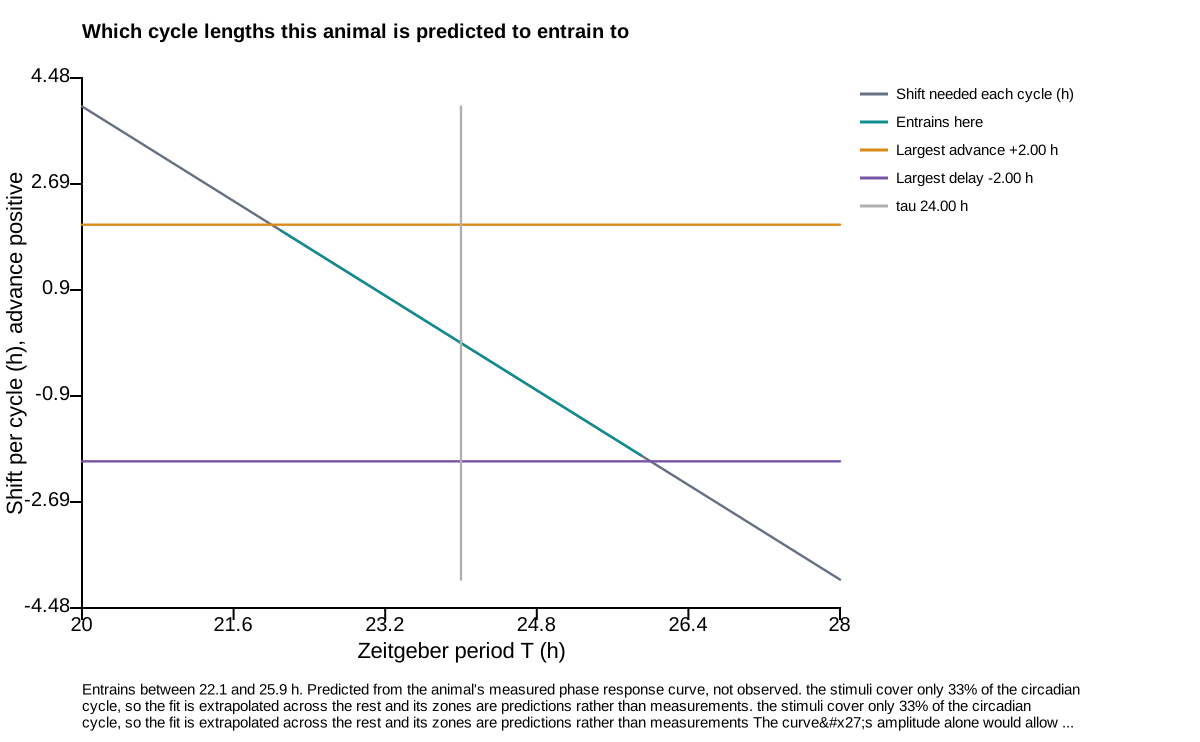
This deterministic example is calculated by the entrainment_range action and drawn by render_entrainment_range_svg, the same renderer used for publication export. Empty or withheld elements are therefore visible exactly as they are in a real result.
import circadian_workbench as cw

cw.call("entrainment_range", curve=prc, tau_hours=24)
Required inputs and controls
The public function is the registered action below. settings= is accepted as a friendlier alias for config= by cw.call; the calculation stores the complete normalized config in provenance.
Function reference
cw.call("entrainment_range", curve, tau_hours, config=None)
Arguments and parameters
| Name | Type | Required | Default | Units | Meaning |
|---|---|---|---|---|---|
curve |
object | yes | — | - | A phase_response_curve result, whole. Its fit is what is iterated; a curve with no fit -- too few animals -- is refused rather than predicted from. |
tau_hours |
number | yes | — | hours | The animal's own free-running period, in hours. The cohort curve does not carry it because a cohort has one per animal. |
config |
object | no | null |
- | Partial analysis config. Missing keys fall back to analysis.DEFAULT_CONFIG and out-of-range values are clamped silently — run describe_config for every key, its default and its allowed values, or normalize_config to see what a given config actually becomes. |
Every nested config key, default, allowed value, and purpose is listed in the complete configuration reference.
How it works
The measured curve is iterated as a phase map over the configured zeitgeber-period grid. Fixed points must supply the required daily correction and pass a local stability test.
$$ \phi_{n+1}=\left{\phi_n+\frac{24T}{\tau}+\Delta(\phi_n)\right}\bmod 24 $$
Implementation: prediction.py::entrainment_range.
Outputs and interpretation
The result includes the tested zeitgeber grid, required and available shifts, fixed points, stability, entrainable mask and ranges, convergence, curve provenance, and limitations.
cw.call returns a Result: use .data for calculated values, .warnings for scientific qualifications, .provenance for version and input identity, .script for an equivalent replay script, and .files for saved outputs.
Limitations
A curve without a fitted periodic model is refused. Predictions remain conditional on the measured curve and do not substitute a generic oscillator model.
Example
The figure above is a real package result from a seeded, redistributable synthetic dataset. Its audited project bundle retains figure_data.csv, a standalone plot.py, source hashes, an editable SVG, and a rendered preview.
Methods text
The accepted phase-response curve was iterated as a discrete phase map across the declared zeitgeber-period grid; entrainment required a stable fixed point supplying the necessary daily phase correction.
See also
Plan sample size · Predict re-entrainment · Fit the two-process sleep model · Analysis index · Gallery